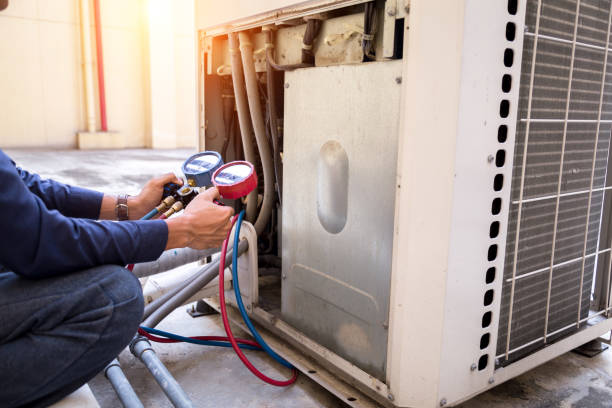
There is a particular kind of vulnerable that only happens when your air conditioning fails in a Dallas August. The house is already warming up. You have no idea what a fair price is for whatever just broke. And the only person who can tell you is standing in your driveway, quoting you a number, and benefiting from that number being high. Most people, in that moment, just say yes.
This guide exists so you do not have to. Knowing what HVAC repair in Dallas actually costs in 2026 is the single best protection a homeowner has against being overcharged, because the overcharge only works when you do not know the real number. Once you do, a padded quote becomes obvious, and the conversation changes completely.
Below are the realistic 2026 price ranges for the most common Dallas AC repairs, what drives the cost up or down, and the specific overcharge tactics worth watching for. A note on the numbers: these are planning ranges drawn from current Dallas-Fort Worth market data, not quotes. Your actual price depends on your equipment, the specific failure, and who you call. Use them to judge whether a quote is in a sane range, not as a guarantee.
First, the fee before any repair: the diagnostic charge
Almost every HVAC repair in Dallas starts with a diagnostic or service-call fee, typically in the range of around eighty-five to one hundred sixty dollars. This covers the technician coming out and figuring out what is wrong, and it applies to any HVAC service in Dallas whether or not you end up proceeding with the work. It is normal and it is fair; nobody diagnoses a system for free.
Two things to know. First, ask whether the diagnostic fee is waived or credited toward the repair if you proceed, because many companies do that and not all mention it unprompted. Second, during a peak-summer emergency or an after-hours call, expect this fee and the labor behind it to climb. Standard labor runs roughly eighty-five to one hundred seventy dollars an hour in the Dallas market; emergency and after-hours labor can run two to three times that. That premium is real and largely legitimate, but it is also the cover under which the worst overcharging happens, which is the whole reason to know the numbers that follow.
The common Dallas AC repairs, and what they actually cost in 2026
Here is the realistic picture, roughly from least to most expensive. The gap between the cheap repairs and the expensive ones is enormous, and that gap is exactly where overcharging lives, because the most common overcharge is making a cheap problem sound like an expensive one.
Capacitor replacement: roughly $150 to $300
The capacitor is a small part that helps the motors start, and it is one of the most common failures on a Dallas system, because Texas heat is hard on capacitors. Here is the most important thing in this entire guide: a failed capacitor is a cheap, fast, routine repair, and it is also the single most common thing dishonest operators use to sell a whole new system. If your AC will not start and someone immediately steers you toward replacement without mentioning the capacitor, be very careful. This is the classic move.
Contactor replacement: roughly $200 to $350
The contactor is an electrical switch that tells the system to turn on. Like the capacitor, it is a wear part, it is relatively inexpensive, and it fails on a normal schedule. Another small, routine repair that should never be the trigger for a replacement conversation on its own.
Thermostat repair or replacement: roughly $120 to $300
Sometimes the system is fine and the thermostat is the problem. On the low end this is a simple swap. The reason it is worth knowing: a thermostat issue can masquerade as a system failure, and you do not want to pay for a system diagnosis when a thermostat was the whole story.
Condensate or drain line clearing: roughly $100 to $250
Your AC pulls a lot of water out of Dallas humidity, and that water drains through a line that clogs with algae over time. When it clogs, it can shut the system down on a safety switch or leak water into your home. Clearing it is one of the cheapest fixes there is, and it is also almost entirely preventable with routine maintenance, worth remembering when the bill arrives.
Refrigerant recharge: roughly $200 to $600 or more
This one needs the most care, because it is where a lot of money quietly leaks out of homeowners. If your system is low on refrigerant, the recharge itself lands in this range depending on the type and amount. But here is the critical point: refrigerant is not fuel. It circulates in a sealed loop and is not consumed. If your system is low, you do not simply need more; you have a leak. Anyone who tops you off without finding and addressing the leak has sold you a temporary fix that you will be paying for again next summer, at a price that keeps rising as older refrigerants get more expensive. A recharge with no mention of a leak search is a yellow flag.
Fan or blower motor: roughly $400 to $900
Now we move into the genuinely mid-range repairs. A failed fan motor, outdoor condenser fan or indoor blower, is a real repair at a real cost, and the range is wide because motors and labor vary. This is a legitimate several-hundred-dollar repair, not a cheap one, but it is also not a reason to replace a system that is otherwise sound.
Evaporator or condenser coil: roughly $250 for a cleaning, $1,000 to $2,500+ for repair or replacement
Coils are where cost starts to get serious. A cleaning is cheap. A leaking or damaged coil is a major repair, and on an older system it is one of the repairs that legitimately starts a repair-or-replace conversation, because a coil replacement is a large enough expense to weigh against the age of the whole unit.
Compressor replacement: roughly $1,500 to $3,500 or more
The compressor is the heart of the system and the most expensive component to replace. This is the big one. On a newer system under warranty, you may owe mostly labor. On an older system, a failed compressor is often the moment replacement genuinely makes more financial sense than repair, not because someone is upselling you, but because the math actually says so. The honest rule of thumb most of the industry uses: when a repair approaches roughly half the cost of a new system, replacement deserves serious consideration.
The overcharge playbook: how to spot it
Now that you know the real numbers, here are the specific tactics that separate a fair HVAC repair in Dallas from an inflated one. None of these means every technician is dishonest, most are not, but these are the patterns worth watching, especially during a summer emergency when your guard is down.
- The jump straight to replacement. The most common and most expensive overcharge. If your AC will not start and the immediate recommendation is a new system, with no mention of a capacitor, a contactor, or a diagnostic breakdown, stop. A cheap part gets dressed up as a dead system more often than any other move in this trade.
- The refrigerant top-off with no leak found. As covered above, a recharge without a leak search is selling you the same problem twice. A refrigerant quote should come with a conversation about where the refrigerant went.
- The vague all-in number. A fair quote itemizes: the part, the labor, the diagnostic. A single large round number with no breakdown is hard to evaluate on purpose. Ask for the line items, and watch whether they add up to the ranges above.
- The pressure to decide right now. Real urgency exists in a Texas summer. Manufactured urgency, pushing you to decide on a major expense this instant, before you can think or get a second opinion, is a sales tactic, not a diagnosis. A real emergency repair and a rushed replacement decision are different things.
- The number far outside these ranges. If a quoted repair is wildly above the ranges here, ask why specifically. There can be legitimate reasons, access, a high-end system, additional damage, but a good technician can explain the gap in plain terms. Evasiveness is the tell.
Why summer makes all of this worse in Dallas
It is worth naming why Dallas homeowners are especially exposed on HVAC repair in Dallas, because the timing is not an accident. Almost every AC failure happens during the same brutal stretch of the year, when demand across the metro is at its absolute peak. That concentration does several things at once, and all of them favor the person holding the quote.
Availability drops, so you feel lucky to get anyone at all, which makes you less likely to shop around. Prices rise with demand, legitimately and sometimes otherwise. And the heat itself creates real pressure: a house climbing past ninety degrees with kids or pets or elderly family inside is a genuine emergency, and genuine emergencies are terrible conditions for careful financial decisions. The overcharge does not work in October. It works in August, and it works precisely because you cannot wait.
The defense is the thing you are doing right now: knowing the numbers before you need them. A homeowner who knows a capacitor is a two-hundred-dollar part does not get sold a seven-thousand-dollar system at ten at night in July. The knowledge is the protection.
The deeper problem the price guide cannot fully solve
Here is the honest limit of everything above. A price guide helps enormously, but it cannot change the underlying structure of the situation, which is this: at the moment you most need unbiased advice about your HVAC system, the person giving it is usually the person who profits from the answer.
That is not a knock on HVAC technicians. Most Dallas HVAC pros are skilled, honest people doing hard work in brutal heat. But the incentive is built into the structure. The company that diagnoses your system also sells the repair and the replacement, and even a fundamentally honest technician is answering a question they have a financial stake in. When the recommendation is a cheap capacitor, that tension does not matter. When it is a seven-thousand-dollar system, it matters enormously, and you are evaluating it alone, in the heat, under pressure.
This is why some Dallas homeowners have moved to a different model entirely: having HVAC repair and service coordinated through an independent party that does not sell equipment, does not earn a commission on the repair, and has no stake in whether the answer is a part or a whole new system. In that arrangement, the party advising you on the quote is structurally on your side of the table rather than the other one. They can look at a replacement recommendation and ask the questions you would not know to ask, get a second opinion without it being awkward, and make sure a capacitor problem stays a capacitor problem. The price guide protects you on the common repairs. Independent coordination is what protects you on the expensive ones, where the stakes and the incentives are both highest.
Whichever route you take, the principle holds: the overcharge depends on your not knowing. Know the numbers in this guide, insist on an itemized quote, refuse to be rushed on a major decision, and get a second opinion whenever the recommendation is replacement rather than repair. Do that, and HVAC repair in Dallas stops being something that happens to you and becomes something you are actually in control of, even in August.